In June–July 2025, the international educational program AI Mindset in Entrepreneurial Spaces took place within the HEI-TRAIN initiative (HEI Transformation for Entrepreneurship and AI-Driven Innovation). AI Mindset in Entrepreneurial Spaces is an international Train-the-Trainers program for instructors, consultants, and business professionals ready to lead in the age of artificial intelligence. The program builds a comprehensive competence set covering digital literacy and the use of AI tools, entrepreneurial thinking and value creation, analytical thinking and data-driven decision-making, communication and presentation skills, pedagogical innovation and digital transformation of courses, as well as the ethical use of AI and adherence to academic integrity. The program attracted registrations from:
- more than 637 participants from Ukraine, Germany, Latvia, Lithuania, Uzbekistan, Tunisia, India, Qatar, Spain, and Canada;
- over 71 representatives of business companies, 5 from government institutions, 21 from NGOs, 17 from startups, 16 from colleges, vocational and secondary schools, 8 from research institutions and consulting firms, and 492 from universities;
- 22 business owners, 10 directors, 11 deans and vice-deans, and 11 rectors and vice-rectors.
Within the AI Mindset in Entrepreneurial Spaces program, the training lasted six weeks and combined online sessions, individual work on a personal project titled “AI Quest for Innovation in Teaching and Training,” and hands-on mentor support — 180 hours in total. This format ensured a consistent transition from theory to AI-based solutions and a public presentation of each participant’s project with professional feedback. Every participant not only received knowledge from leading experts but also worked on their own project, “From Idea to Impact: Creating AI-Oriented Prototypes,” which was presented at the end of the program.
Training topics in AI Mindset in Entrepreneurial Spaces:
- Saulius Kromalcas (Mykolas Romeris University, Lithuania) spoke on AI-oriented strategies for innovation and competitive business positioning.
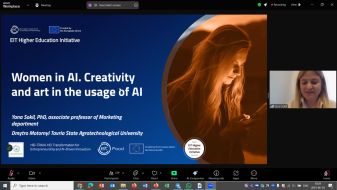
- Yana Sokil (Tavria State Agrotechnological University) covered the role of women in AI and creative approaches to its use, and examined corporate social responsibility in digital entrepreneurship.
- Pavlo Sidelov, representative of Techfiz UAB (Lithuania) and lecturer at Pryazovskyi State Technical University, presented modules on strategic management in the AI-startup lifecycle and on methods for assessing AI-startup potential through global scaling and analysis, with particular attention to the ethical and social aspects of AI use.
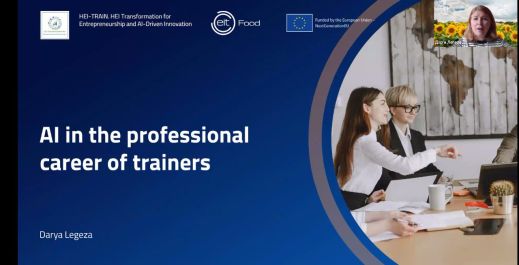
- Darya Legeza (Tavria State Agrotechnological University, Ukraine) conducted a training on applying AI and VR to the sustainable development of the food industry and their place in it. She also highlighted the benefits of using AI in the professional development of trainers and instructors.
- Dr. Tetiana Gorokhova (Center for Advanced Internet Studies, CAIS, Germany) discussed entrepreneurship and global transformations in the digital era.
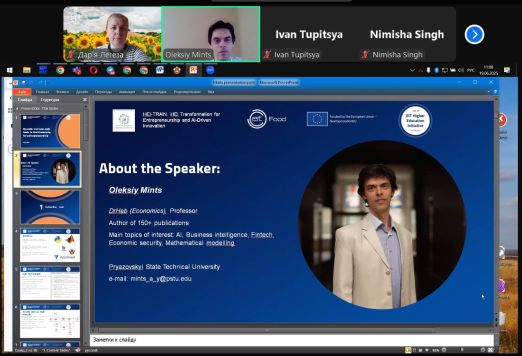
- Prof. Oleksiy Mints (Pryazovskyi State Technical University) addressed no-code and low-code tools in the AI economy for entrepreneurship.
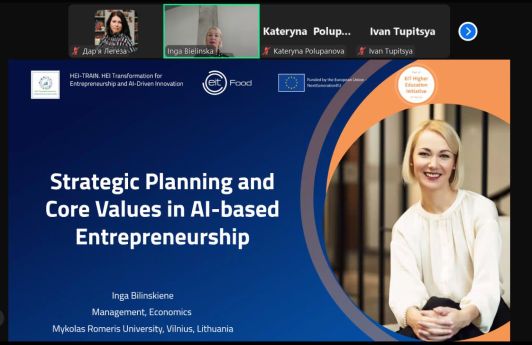
- Inga Bielinskienė (Mykolas Romeris University, Lithuania) explored strategic planning and core values in AI-driven entrepreneurship.
- To conclude the training cycle, Raitis Sevelis (ISMA University of Applied Sciences, Latvia) held a session presenting the opportunity to create a personal project in Rapid Visual: a Canva-based business model.
An important contribution of the program was the set of sessions by invited speakers, rich with real-world cases showing how AI is transforming business, science, medicine, and services. Participants learned how startups, hotels, and B2B companies apply AI tools for automation and growth; they explored behavior-based automation strategies and customer communication; and they saw how AI improves medical diagnostics and rehabilitation. Key highlights included smart growth with AI tools from German startups, AI-based B2B business models and tender procurement, intelligent hotel services and dynamic pricing with AI, and the use of AI in orthopedics and traumatology.
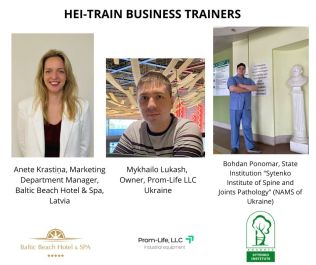
We extend sincere thanks to experts who shared their hands-on AI experience — Alina Nikolaichuk (Germany), HR specialist and co-founder of Parrino Riserva; Mykhailo Lukash, owner of Prom-Life LLC (Ukraine); Anete Krastiņa, Marketing Manager at Baltic Beach Hotel & Spa (Latvia); Bohdan Ponomar from the State Institution “Sytenko Institute of Spine and Joint Pathology of the National Academy of Medical Sciences of Ukraine”; and Dr. Tetyana Oleksiyuk, Vice-President of the Access Info Group at the Council of Europe, who delivered the talk “Open Data in Europe for Research and Business.”
More details about AI Mindset in Entrepreneurial Spaces events are available in the group: https://www.facebook.com/groups/595501706318569