

In 2023, Dmytro Motornyi Tavria State Agrotechnological University enrolled 2,330 applicants.
A total of 1381 applicants were enrolled in the Bachelor’s degree programmes, including 344 women, making up 24.9% of the total. A total of 949 applicants were enrolled in the Master’s degree programmes, with 195 women representing 20.5% of the total. The overall share of female applicants in 2023 is 23.1% with the highest proportion of women enrolled in economics majors.
At the Bachelor’s degree level, there are 10 specialities in TSATU where the share of women exceeds 50%: Accounting and Taxation, Hotel and Restaurant Business, Entrepreneurship and Trade, Ecology, Computer Science, Finance, Banking, Insurance and Stock Market, Marketing, Food Technology, Geodesy and Land Management, Tourism and Recreation. At the Master’s degree level, the share of women in two specialities, Accounting and Taxation and Marketing, exceeds 50%.
Admission to the university for higher education is based on gender-neutral admission processes that ensure equal treatment of all applicants, regardless of their gender. In order to minimize gender bias and create equal opportunities for all applicants, competitive selection is based solely on the applicant’s achievements, including entrance exam results and motivation letters. The University, both at the stage of admission and during the course of study, pursues a policy of avoiding the influence of gender stereotypes and ensures that decisions (for example, on enrolment or awarding academic scholarships to students) are made solely based on applicants’ actual abilities and achievements.
TSATU provides opportunities for women to access education through career guidance, information on government support programmes and personalized scholarships. In accordance with the Regulations on the Procedure for Awarding Scholarships to TSATU Students, all university students, including women, are eligible to receive academic scholarships based on the results of semester control and personalized academic scholarships for special academic achievements.
In 2023, the following students were awarded personalized academic scholarships: Polina Chernyshova, a TSATU student, received a scholarship of the Cabinet of Ministers of Ukraine; Yuliia Nakonechna, a TSATU student, received a scholarship of the Verkhovna Rada of Ukraine.
Due to the full-scale invasion, many people lost their jobs. As a result of migration and mobilization, employers faced a significant shortage of staff, including highly qualified personnel. The share of women among job seekers has increased.
In 2023, TSATU students, majority of whom are women, became participants in the “Professional Orientation. Career. Entrepreneurship” project, implemented by Booster Development with the support of the USAID Economic Support for Ukraine Programme. This project is particularly relevant for those individuals who have lost their jobs due to forced displacement. One of the prerequisites for participation in the project is obtaining a second higher education in the programme areas. Through the project, participants have the opportunity to pay for their education at TSATU using a financial voucher under the “Voucher for Education” programme.
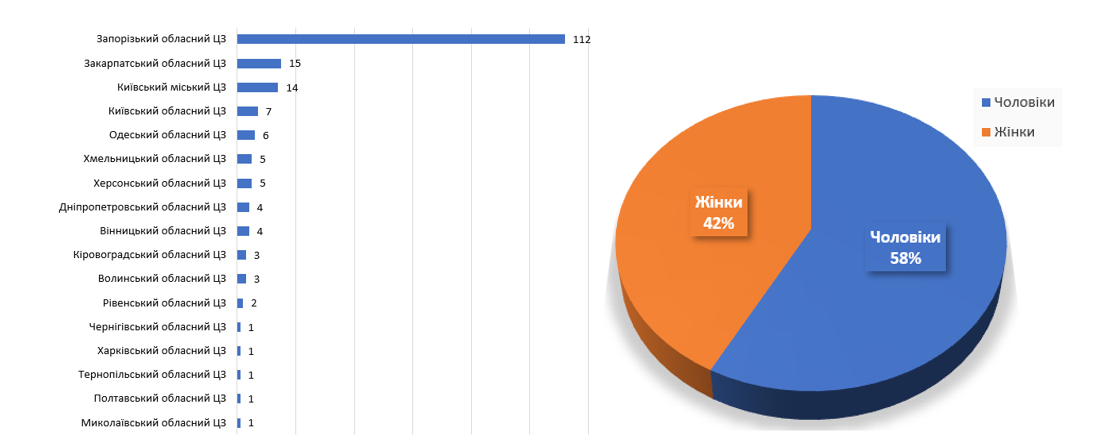
The university regularly conducts career guidance work within regional communities with the involvement of representatives of employment centres on the possibility of obtaining higher education with a voucher. Thus, in 2023, 185 TSATU applicants received vouchers to pay for education, including 78 women (42%).
а) б)
Figure 5.1. Information on TSATU applicants by vouchers: a) distribution of issued vouchers by regional employment centres; b) gender distribution among voucher recipients.
The university provides women with advisor support on admission, mentoring, and information on the possibility of receiving financial support.
Every year, the Academic Council of TSATU develops a career guidance plan that includes communication with graduates of educational institutions, meetings with representatives of professional associations, human resources departments of industrial enterprises and farms, and volunteer educational events for school and college graduates.
In order to better understand their natural inclinations and abilities to master a particular profession, TSATU applicants have the opportunity to seek the help of a career advisor, who is approved by the rector for each speciality. Career advisors conduct online surveys to identify women’s abilities and determine the direction of their future studies, provide information about educational programs, study conditions, and organize online meetings with the head of the department and the dean to establish direct contact between the applicant and the advisor, applicants can fill out a form that will result in the appointment of a career advisor. Based on the results of cooperation with Booster Development, female participants of the “Professional Orientation. Career. Entrepreneurship” project entered TSATU to Master’s degree programmes.
Women represent a significant portion of the academic staff at TSATU. In 2023, the university employed 605 staff members, including 206 academic staff members. Among the academic staff, 131 were associate professors and professors, with women making up 91 of these positions (69.5%). TSATU has a policy that states that there are no discriminatory measures against women. All employees are hired according to identical qualification requirements for positions, both men and women (http://www.tsatu.edu.ua/wp-content/uploads/polozhennja_pro_provedennja_konkursu_na_zamishchennja_vakantnyh_posad_npp.pdf ) and are equally entitled to all economic, social, cultural and other rights, respectively, in accordance with the University Collective Agreement. According to Article 24 of the Constitution of Ukraine, the Law of Ukraine “On Ensuring Equal Rights and Opportunities for Women and Men” and the Law of Ukraine “On Principles of Prevention and Combating Discrimination in Ukraine”, women are granted equal opportunities with men in social, political and cultural activities, education and vocational training, work and remuneration; special measures for the protection of women’s health and labour, establishment of pension benefits; creation of conditions that allow women to combine work and motherhood; legal protection, material and moral support for motherhood and childhood, including the provision of paid leave and other benefits to pregnant women and mothers.
TSATU supports women’s participation in career development and educational and research activities. In accordance with the Collective Agreement of Dmytro Motornyi Tavria State Agrotechnological University (http://www.tsatu.edu.ua/wp-content/uploads/kolektyvnyj-dohovir-2023-rik.pdf) and the Law of Ukraine “On Leaves”, women are granted parental leave until the child reaches the age of 3 or 6 (if necessary), additional leave is granted to women with two or more children under the age of 15 or a child with a disability, or those who are single mothers, etc. Women also have the right to work part-time.
Within the framework of the ERASMUS+ project 618270-EPP-1-2020-1-LT-EPPKA2-CBHE-JP Digitalization of the economy as an element of sustainable development of Ukraine and Tajikistan (DigEco), a 30-hour Crash course The Digital Economy as an Element of Sustainable Development of the Enterprise was organized (See Crash courses section, Certificates of participants file. The courses were organized by Ukrainian partner universities: State Higher Educational Institution “Azov State Technical University”, State Higher Educational Institution “Admiral Makarov National University of Shipbuilding”, State University “Zhytomyr Polytechnic”, Kamianets-Podilskyi Ivan Ohiienko National University, and Dmytro Motornyi Tavria State Agrotechnological University. The courses were attended by 144 participants, including 94 women (65%). TSATU invited 17 participants, including 12 women (70.6%).
The university is able to track changes in the number of women and men who have studied in educational programmes and completed their studies. This information is uploaded to the Unified State Electronic Database on Education.
TSATU systematically analyses information on students who did not complete their studies for various reasons. Thus, in 2023, out of the planned number of bachelor’s degree graduates, 620 bachelor’s degree graduates completed their studies, with women making up 31%. At the same time, 308 students did not complete their studies and were expelled, including 100 women. Out of the planned number of graduates, 305 students completed their master’s degree programmes, with women making up 35%. At the same time, 84 students did not complete their studies and were expelled, including 22 women.
To protect students and employees from any penalties when reporting discriminatory situations, TSATU adheres to the Regulations on the Primary Trade Union Organization of Employees and Students. In accordance with clause 1.9, the trade union organization of TSATU protects all members of the team who take an active stance and courageously report discrimination from unfavourable conditions in education or employment.
In accordance with the Law on Leaves, Article 18, a person who has adopted a child from among orphans or children deprived of parental care is granted a one-time paid leave of 56 calendar days for the adoption process. Pursuant to the Collective Agreement of TSATU and Article 18 of the Law of Ukraine “On Vacations”, parental leave for the care of a child until the child reaches the age of three may be taken, in whole or in part, by either of the child’s parents, grandparents or other relatives who actually care for the child, or by a person who adopted or took custody of the child, one of the foster parents. In accordance with the Collective Agreement of TSATU and Article 77-3 of the Labour Code of Ukraine, a one-time paid leave of up to 14 calendar days may be granted upon the birth of a child, to the child’s grandparents or other adult relatives who actually takes care of the child.